The Olympic archery distance is 70 meters. This article will cover everything you need to know about the archery target distance in the Olympics, including the Olympic archery range, distance in Olympic archery history, rules, equipment, and more. Whether you’re a seasoned archer or a curious spectator, this comprehensive guide will provide valuable insights into the world of Olympic archery and archery competition distance.
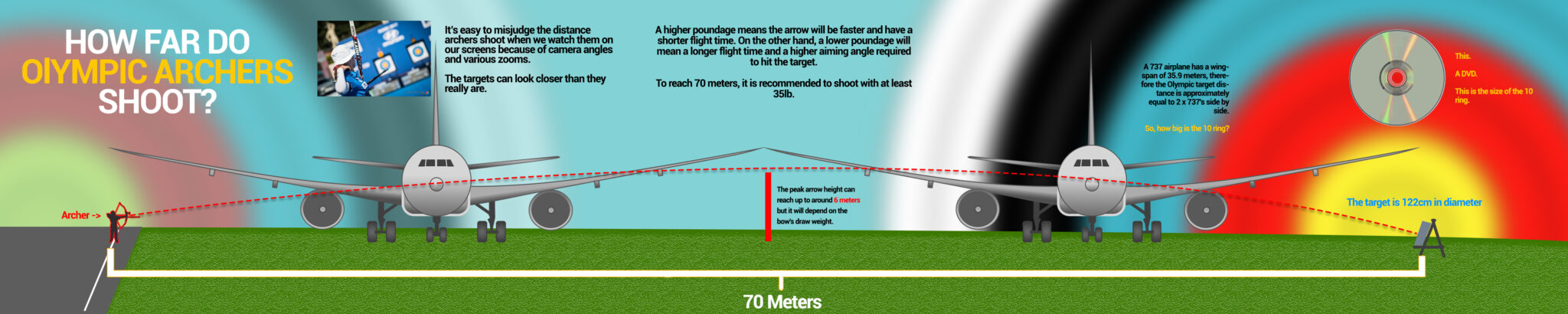
Image Source: www.onlinearcheryacademy.com
The Standard Distance: 70 Meters
In Olympic archery, archers shoot at a target placed 70 meters (approximately 76.5 yards) away. This standard archery distance has been the norm for many years and is governed by international archery target range regulations set by World Archery, the sport’s international governing body.
Why 70 Meters?
The 70-meter distance wasn’t chosen arbitrarily. It’s a challenging distance that requires a blend of skill, precision, and physical stamina. At this range, factors like wind, temperature, and even the archer’s heartbeat can significantly affect the arrow’s trajectory.
Deeper Look at the Olympic Archery Range
The Olympic archery range isn’t just an open field with targets. It’s a carefully designed space that considers many factors to ensure fair competition. The requirements outlined in the Olympic archery specifications ensure the safety and equity of the event.
Key Features of an Olympic Archery Range:
- Flat Ground: The shooting line and target area must be on level ground to prevent unfair advantages.
- Target Butts: These are large, rectangular structures made of materials like straw or foam. They stop the arrows safely and allow for easy scoring.
- Target Faces: These are the colorful targets with concentric rings. The standard target face is 122 cm in diameter.
- Shooting Line: This is the line that archers must stand behind when shooting.
- Waiting Line: This is where archers wait their turn to shoot.
- Safety Zones: These are areas around the range that are kept clear to ensure the safety of archers, officials, and spectators.
Detailed Layout:
| Feature | Description |
|---|---|
| Shooting Line | Marked line where archers stand while shooting. |
| Target Butts | Structures designed to safely catch arrows. |
| Target Faces | The actual targets with scoring rings that archers aim for. |
| Waiting Line | Designated area for archers awaiting their turn to shoot, ensuring organized and safe flow during the competition. |
| Safety Zones | Clearly defined areas around the archery range to ensure the safety of archers, officials, and spectators from stray arrows. |
The Archery Target: A Closer View
The target in Olympic archery is a crucial part of the competition. Its design and dimensions are precisely defined to ensure fairness.
Target Dimensions:
- Diameter: 122 cm (approximately 48 inches)
- Scoring Rings: Ten concentric rings, each with a different point value.
- Colors: From the center outward: gold (10 and 9 points), red (8 and 7 points), blue (6 and 5 points), black (4 and 3 points), and white (2 and 1 points).
Scoring System:
- The center ring (gold) is worth 10 points.
- The outermost ring (white) is worth 1 point.
- If an arrow lands between two rings, the higher score is awarded.
- Arrows that miss the target completely score zero points.
Archery Equipment: The Archer’s Tools
Olympic archers use recurve bows, which are traditional-looking bows with curved limbs. The equipment is governed by strict rules.
Key Equipment Components:
- Recurve Bow: The bow used in Olympic archery.
- Arrows: Made of carbon or aluminum, with fletchings (feathers or vanes) to stabilize flight.
- Finger Tab or Glove: Protects the archer’s fingers when drawing the string.
- Armguard: Protects the archer’s forearm from the bowstring.
- Sight: Helps the archer aim accurately.
- Stabilizer: Reduces vibration and improves balance.
- Clicker: A device that indicates when the archer has reached full draw length.
Restrictions on Equipment:
- Bows must not have any electronic or mechanical aiming devices other than a sight.
- Arrows must conform to specific weight and diameter limits.
- The use of laser sights or rangefinders is prohibited.
Rules and Regulations Governing the Distance in Olympic Archery
World Archery sets the rules for Olympic archery, and these rules are very specific about the distance and other aspects of the competition. These archery distance regulations are updated periodically.
Key Rules Regarding Distance:
- All archers must shoot from the designated shooting line at 70 meters.
- The distance is measured from the shooting line to the center of the target.
- If the distance is incorrect, the competition must be stopped, and the distance must be corrected before resuming.
Other Important Rules:
- Archers must follow a strict shooting order.
- Archers must not interfere with other archers.
- Archers must adhere to all safety regulations.
- Dress code, including apparel and footwear, is strictly enforced.
The Impact of Weather Conditions
Weather can significantly impact archery, especially at 70 meters. Wind, rain, and temperature can all affect the arrow’s flight.
Wind:
- Wind is the most significant weather factor.
- Archers must adjust their aim to compensate for wind drift.
- Strong winds can make it very difficult to shoot accurately.
Rain:
- Rain can make the bowstring slippery.
- Rain can also affect the archer’s grip and balance.
- Archers may use umbrellas or other rain gear to stay dry.
Temperature:
- Temperature can affect the arrow’s flight characteristics.
- Hot temperatures can cause the air to become less dense, which can cause the arrow to fly higher.
- Cold temperatures can cause the air to become denser, which can cause the arrow to fly lower.
Training and Techniques for Shooting at 70 Meters
Shooting accurately at 70 meters requires years of training and practice. Archers must develop a consistent shooting technique and strong mental focus.
Key Training Elements:
- Form: Develop a consistent shooting form.
- Strength: Build the strength and endurance needed to hold the bow steady.
- Mental Focus: Develop the mental focus needed to block out distractions and concentrate on the target.
- Practice: Practice regularly at different distances and in different weather conditions.
Techniques for Shooting at 70 Meters:
- Aiming: Use a sight to aim accurately.
- Drawing: Draw the bowstring smoothly and consistently.
- Anchoring: Anchor the bowstring at the same point on the face each time.
- Release: Release the bowstring smoothly and cleanly.
- Follow-Through: Maintain a consistent follow-through after the release.
The Evolution of Olympic Archery
Olympic archery has changed over the years, with developments in equipment and regulations.
Historical Overview:
- Archery was included in the Olympic Games from 1900 to 1920.
- It was then dropped from the program for several decades.
- Archery was reintroduced to the Olympics in 1972.
- Since then, it has become a permanent part of the Olympic program.
Changes in Equipment and Rules:
- Early Olympic archers used wooden bows and arrows.
- Today, archers use advanced recurve bows made of composite materials.
- The rules and regulations have also evolved over time to ensure fairness and safety.
Famous Olympic Archers
Many archers have achieved fame in Olympic archery, setting records and inspiring future generations.
Notable Olympic Archers:
- Darrell Pace (USA): Two-time Olympic champion and considered one of the greatest archers of all time.
- Kim Soo-Nyung (South Korea): Multiple Olympic gold medalist and a dominant force in women’s archery.
- Park Sung-Hyun (South Korea): Known for her incredible accuracy and multiple Olympic medals.
Interpreting the Scoring System
The scoring system in Olympic archery can seem complicated at first, but it is essential to understand. Each ring on the target corresponds to a point value, and the archer with the highest score wins.
How to Score in Olympic Archery:
- Each arrow that lands within a scoring ring earns points based on the ring’s value.
- The closer the arrow is to the center of the target, the higher the score.
- The archer with the highest total score at the end of the competition wins.
Tie-Breaking Procedures:
- If two or more archers have the same score, a tie-breaking procedure is used.
- The tie-breaking procedure usually involves shooting additional arrows until a winner is determined.
Grasping the Mental Game
Olympic archery is not just a physical sport; it is also a mental one. Archers must be able to control their emotions, focus on the target, and block out distractions.
Mental Strategies for Olympic Archery:
- Visualization: Visualize the perfect shot before each arrow.
- Positive Self-Talk: Use positive self-talk to boost confidence.
- Focus: Concentrate on the target and block out distractions.
- Relaxation: Relax and breathe deeply to reduce tension.
- Resilience: Bounce back from mistakes and stay focused on the next shot.
The Future of Olympic Archery
Olympic archery continues to evolve, with new technologies and training methods emerging all the time.
Emerging Trends:
- Advanced Equipment: New materials and designs are constantly being developed to improve the performance of bows and arrows.
- Improved Training Methods: New training methods are being developed to help archers improve their physical and mental skills.
- Increased Popularity: Archery is becoming more popular worldwide, with more people taking up the sport.
Potential Changes:
- The rules and regulations of Olympic archery may continue to evolve to ensure fairness and safety.
- New formats and events may be added to the Olympic program to make the sport more exciting and engaging for spectators.
FAQ Section
Q: What is the Olympic archery distance?
A: The Olympic archery distance is 70 meters (approximately 76.5 yards).
Q: Can I use any type of bow in Olympic archery?
A: No, only recurve bows are allowed in Olympic archery. Compound bows are used in other archery competitions but not in the Olympics.
Q: What size is the archery target used in the Olympics?
A: The target is 122 cm (approximately 48 inches) in diameter.
Q: Who is the governing body for Olympic archery?
A: World Archery is the international governing body for archery, including Olympic archery.
Q: What are the scoring zones on an Olympic archery target?
A: The scoring zones, from the center outward, are gold (10 and 9 points), red (8 and 7 points), blue (6 and 5 points), black (4 and 3 points), and white (2 and 1 points).
Q: What happens if there is a tie in Olympic archery?
A: Tie-breaking procedures involve shooting additional arrows until a winner is determined.
Q: How do weather conditions affect archery at 70 meters?
A: Weather conditions such as wind, rain, and temperature can significantly affect the arrow’s flight, requiring archers to adjust their aim accordingly.
Q: Are there any restrictions on the equipment used in Olympic archery?
A: Yes, there are strict regulations on the type of bow, arrows, and aiming devices that can be used. Electronic or mechanical aiming devices other than a sight are prohibited.
Q: What is the distance from the shooting line to the target in Olympic archery?
A: The distance from the shooting line to the center of the target is 70 meters.
Q: What is the standard archery distance used in Olympic competitions?
A: The standard distance in Olympic archery is 70 meters.
Step into the electrifying world of Olympic archery and unlock a precise understanding of its competitive arena. From the exact target dimensions to the intricate layout of the official Olympic range, this guide offers a deep dive for every enthusiast, seasoned competitor, or curious spectator, equipping you with a firm grip on this captivating pursuit.

Hi, I’m Robert Contreras, a passionate archery instructor based in the USA. With years of experience under my belt, I’ve dedicated my life to mastering the art of archery and sharing its intricacies with enthusiasts of all levels. Through my website, 10Bows.com, I invite you to explore a treasure trove of tips, techniques, and personal insights that reflect my journey in the world of archery. Whether you’re picking up a bow for the first time or refining your skills, I’m here to help guide you toward precision, focus, and a deeper appreciation for this timeless sport.