How do you score archery? Archery scoring depends on the archery scoring system being used. It involves shooting arrows at a target and then counting the archery points based on where they land. Different archery scoring methods exist, each with its own archery scoring rules and way to calculate archery score. This guide provides a comprehensive overview of archery competition scoring, including how to use an archery score sheet and even archery scoring apps.
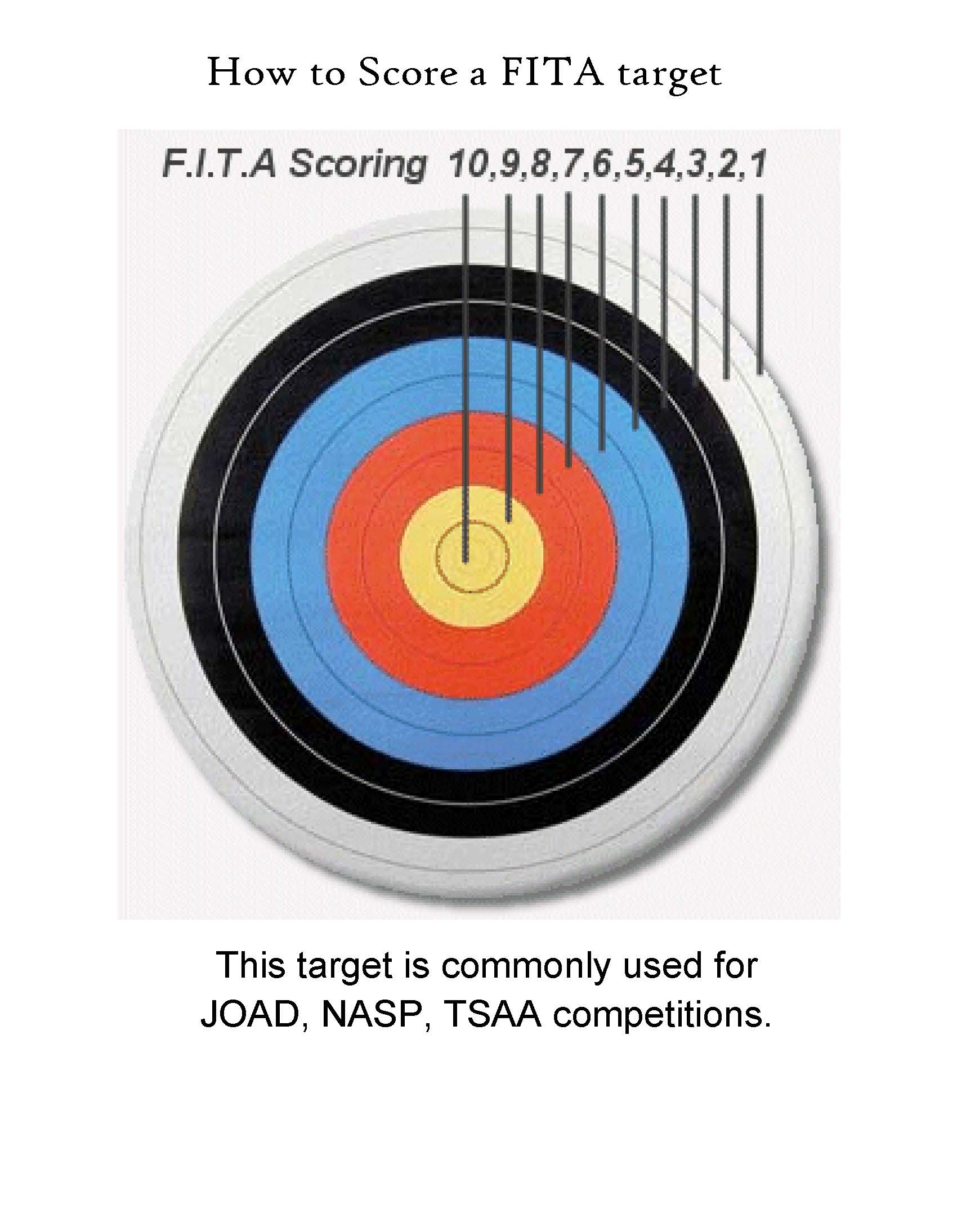
Image Source: texasarchery.info
The Basics of Archery Scoring
Scoring in archery isn’t just about hitting the target. It is about precision and consistency. It is essential to know the rules to archery scoring rules and how to keep track of your score and that of others. Let’s explore the fundamental concepts.
Target Faces: The Key to Scoring
The archery target scoring system revolves around the target face. The target face is divided into concentric rings, each assigned a specific point value. Here’s a breakdown:
- Gold (Inner Rings): Worth the most points. These are typically the yellow rings in the center.
- Red: Surrounds the gold and awards slightly fewer points.
- Blue: Beyond the red, with a lower point value than the previous rings.
- Black: Further out, with even fewer points than the blue rings.
- White (Outer Rings): The outermost rings, awarding the fewest points.
- Miss (Outside White): If the arrow misses the target face completely, it’s usually scored as a miss (M) or zero points (0).
The specific dimensions and colors of the target face can vary depending on the type of archery scoring system used (e.g., World Archery, NFAA). We’ll cover these differences later.
How Points are Awarded
Points are assigned based on where the arrow lands within the target face. Here’s the general archery points system:
- 10 & 9 Points: Awarded for arrows landing in the gold rings (sometimes split into inner and outer gold).
- 8 & 7 Points: Awarded for arrows landing in the red rings.
- 6 & 5 Points: Awarded for arrows landing in the blue rings.
- 4 & 3 Points: Awarded for arrows landing in the black rings.
- 2 & 1 Points: Awarded for arrows landing in the white rings.
- 0 Points or M: Awarded for a complete miss.
Important Note: If an arrow lands on the line between two scoring zones, it is awarded the higher score.
The Importance of Scoring Etiquette
Archery is a sport built on honesty and respect. Therefore, archery competition scoring requires good etiquette:
- Call Your Arrows: After each end (a set of arrows shot), call out your scores clearly and in descending order (highest to lowest).
- Verify Scores: Allow your fellow archers to verify your scores and confirm they are recorded accurately.
- Don’t Touch Arrows Until Scored: Do not touch any arrows in the target until all scores have been called and recorded. This ensures no disputes arise.
- Respect the Target: Treat the target with respect. Avoid unnecessary handling.
- Resolve Disputes Fairly: If there is a disagreement about a score, calmly and respectfully discuss it. If a resolution can’t be reached, consult a judge or tournament official.
Different Archery Scoring Systems
While the basic principles of archery target scoring remain consistent, various archery scoring methods exist, each with its own nuances. Here are some of the most common:
World Archery (WA) Scoring
World Archery (WA) governs international archery competitions, including the Olympics.
- Target Face: Typically uses a 122cm target face for outdoor competitions. Indoor rounds may use smaller target faces (80cm or 40cm).
- Scoring Zones: 10 rings, numbered 1 through 10 (10 being the center). The gold is often split into an inner 10 (X) and an outer 10.
- Distance: Varies depending on the event. Outdoor distances are commonly 70m for recurve archers and 50m for compound archers.
- Arrow Value: Ranges from 1 to 10, with the center gold scoring 10.
WA Scoring Table
| Color | Score |
|---|---|
| Gold | 10, 9 |
| Red | 8, 7 |
| Blue | 6, 5 |
| Black | 4, 3 |
| White | 2, 1 |
National Field Archery Association (NFAA) Scoring
The NFAA is a popular organization in the United States, with its own unique archery scoring rules.
- Target Face: Uses a variety of target faces, including the classic black and white target and the five-color target.
- Scoring Zones: Varies depending on the target face. The five-color target has rings worth 5, 4, 3, 2, and 1 points.
- Distances: Varies widely depending on the type of field round. NFAA competitions often involve shooting at unmarked distances.
- Arrow Value: Ranges from 1 to 5, with the center ring scoring 5.
NFAA Scoring Table (Five-Color Target)
| Color | Score |
|---|---|
| White | 5 |
| Black | 4 |
| Blue | 3 |
| Red | 2 |
| Gold | 1 |
Indoor Archery Association (IAA) Scoring
The IAA offers various indoor archery formats, with different rules.
3D Archery Scoring
3D archery involves shooting at life-sized animal targets. The archery scoring system is different from target archery.
- Target: Life-sized 3D animal targets.
- Scoring Zones: Typically have a vital area (heart and lungs) worth the most points, followed by a body area and then the rest of the animal.
- Arrow Value: Varies depending on the organization and the specific event, but common scoring zones include:
- Vital (10 or 11 points): The heart and lung area.
- Body (8 points): The rest of the torso.
- Miss (0 points): Anywhere else.
Tools for Scoring: Score Sheets and Apps
Keeping track of your score is vital in archery. Traditionally, archers used archery score sheets. Nowadays, archery scoring apps are also popular.
Archery Score Sheets
An archery score sheet is a paper document used to record scores during practice or competition. It typically includes:
- Archer’s Name: Identifies the archer.
- Date and Location: Records when and where the shooting took place.
- Round Type: Specifies the type of round being shot (e.g., WA 70m, NFAA Field).
- End Scores: Columns for recording the score of each end (set of arrows).
- Running Total: A column to keep a running total of the score.
- Final Score: The total score for the entire round.
Here’s an example archery score sheet table:
| End | Arrow 1 | Arrow 2 | Arrow 3 | Arrow 4 | Arrow 5 | Arrow 6 | End Total | Running Total |
|---|---|---|---|---|---|---|---|---|
| 1 | ||||||||
| 2 | ||||||||
| 3 | ||||||||
| … | ||||||||
| Total |
Archery Scoring Apps
Archery scoring apps are digital tools that allow you to record and track your scores on a smartphone or tablet. These apps offer several advantages:
- Convenience: Easily record scores without carrying a paper score sheet.
- Accuracy: Reduces the risk of calculation errors.
- Statistics: Provides detailed statistics about your performance, such as average score per end, hit percentage, and more.
- Sharing: Allows you to share your scores with friends, coaches, or online communities.
Popular archery scoring apps include:
- Archer’s Mark: A comprehensive app for tracking scores, practice sessions, and equipment.
- MyTargets: A simple and user-friendly app for recording scores during target archery.
- IANSEO Scorekeeper: A popular app used in many archery competitions.
How to Calculate Archery Score
How to calculate archery score depends on the format.
Step-by-Step Calculation (Target Archery)
Here’s how to calculate archery score in target archery, using the WA system as an example:
- Shoot an End: Shoot a set of arrows (usually 3 or 6) at the target.
- Call Your Arrows: Call out your scores in descending order (highest to lowest).
- Record Scores: Record each arrow’s score on your archery score sheet or in your archery scoring app.
- Calculate End Total: Add up the scores of all the arrows in that end.
- Calculate Running Total: Add the end total to your previous running total.
- Repeat: Repeat steps 1-5 for each end of the round.
- Calculate Final Score: Add up all the end totals to get your final score.
Example Calculation
Let’s say you shot six arrows and scored: 10, 9, 8, 8, 7, 6.
- End Total: 10 + 9 + 8 + 8 + 7 + 6 = 48
- Record: Record 48 as the end total on your archery score sheet.
- Running Total: If this is your first end, your running total is also 48. If your previous running total was 100, your new running total would be 100 + 48 = 148.
Tie-Breaking Procedures
In many archery competition scoring systems, tie-breaking procedures are in place to determine the winner when two or more archers have the same score. Common tie-breaking methods include:
- Countback: Comparing the number of 10s (or Xs) shot by each archer. The archer with the most 10s wins. If the tie persists, the number of 9s, 8s, etc., are compared.
- Shoot-Off: Each archer shoots one or more arrows at the target. The archer with the highest score in the shoot-off wins.
Deciphering Archery Scoring Rules
The archery scoring rules can be complex, but it’s vital to understand them before competing. Here are a few of the more obscure rules:
Bouncing Arrows
If an arrow bounces off the target face, it usually scores zero points unless there is clear evidence that it hit a higher scoring zone before bouncing.
Pass-Throughs
If an arrow passes completely through the target, it’s usually scored based on the point where it entered the target face, if that can be determined. If the entry point is unclear, the arrow may be scored as a miss.
Equipment Failure
If an archer experiences equipment failure during a competition, they may be allowed to shoot replacement arrows, but only with the permission of a judge or tournament official. The scores of the replacement arrows will count towards their total score.
Scoring Disputes
If there is a dispute about a score, the archers involved should attempt to resolve it amicably. If they cannot reach an agreement, they should consult a judge or tournament official, who will make a final decision.
Tips for Accurate Scoring
Accurate scoring is crucial for fair play. Here are some tips to ensure you’re scoring correctly:
- Pay Attention: Focus on each arrow as you call and record the score.
- Double-Check: Verify the scores with your fellow archers before recording them.
- Use a Score Sheet or App: These tools can help prevent errors.
- Be Honest: Always call your scores accurately, even if it means giving yourself a lower score.
- Ask for Help: If you are unsure about a score, ask a more experienced archer or a judge for assistance.
Fathoming Advanced Scoring Techniques
Once you’ve mastered the basics, you can explore some advanced scoring techniques to enhance your performance.
Aiming Strategies
Experiment with different aiming strategies, such as:
- Gap Shooting: Using the gap between the arrow point and the target to compensate for distance.
- String Walking: Moving your fingers up or down the string to adjust the arrow’s trajectory.
- Point of Aim: Aiming at a specific point above or below the target to compensate for distance.
Mental Preparation
Develop a pre-shot routine to help you focus and calm your nerves. Visualization techniques, such as imagining yourself shooting a perfect score, can also be helpful.
Equipment Optimization
Experiment with different equipment setups to find what works best for you. This may involve adjusting your bow’s draw weight, arrow length, or fletching configuration.
FAQ: Frequently Asked Questions
- What is the highest score possible in a World Archery 70m round? The highest score possible in a World Archery 70m round (72 arrows) is 720 points.
- Can I use a phone app during a competition? Yes, archery scoring apps are generally allowed in competitions, but it’s always best to check the specific rules of the tournament beforehand.
- Who is responsible for calling the scores? The archer who shot the arrows is responsible for calling the scores.
- What happens if my arrow breaks in the target? If your arrow breaks in the target, it’s scored based on where the point of the arrow is located. If the point is in a scoring zone, you get that score.
- How do I handle a scoring dispute? Calmly discuss it with your fellow archers. If you can’t resolve it, consult a judge or tournament official.
- What are the different archery scoring methods? The different archery scoring methods include World Archery (WA), National Field Archery Association (NFAA), Indoor Archery Association (IAA) Scoring, and 3D Archery Scoring.
Master the intricacies of archery scoring and commit to rigorous practice, and you’ll transform into a formidable competitor. Meet the challenge head-on, sharpen your precision, and savor the deep fulfillment of consistently finding the bullseye!

Hi, I’m Robert Contreras, a passionate archery instructor based in the USA. With years of experience under my belt, I’ve dedicated my life to mastering the art of archery and sharing its intricacies with enthusiasts of all levels. Through my website, 10Bows.com, I invite you to explore a treasure trove of tips, techniques, and personal insights that reflect my journey in the world of archery. Whether you’re picking up a bow for the first time or refining your skills, I’m here to help guide you toward precision, focus, and a deeper appreciation for this timeless sport.