The olympic archery distance is 70 meters. This article will explain everything about the distances involved in Olympic archery, including the archery target distance olympics, the olympic archery range length, the size of the target, and more.
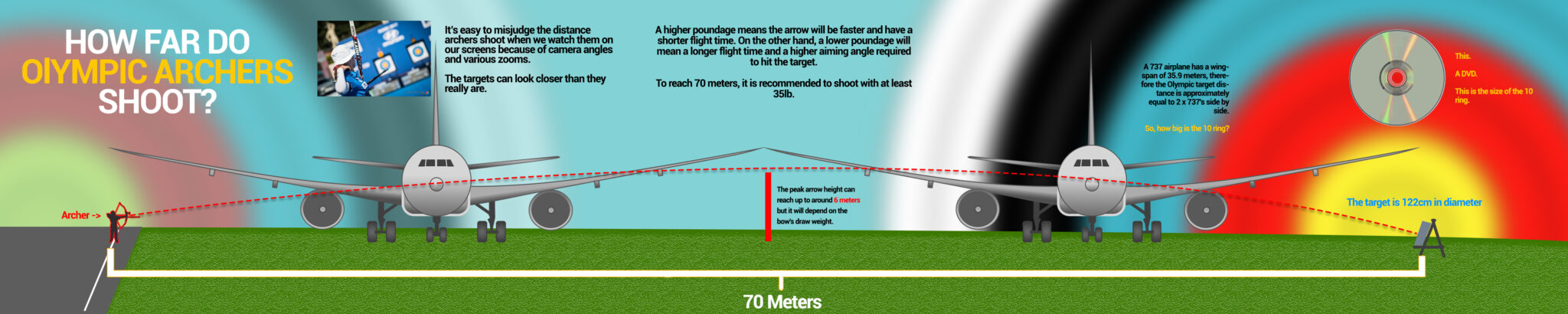
Image Source: www.onlinearcheryacademy.com
Deciphering Olympic Archery Distances
Archery in the Olympics is a test of precision, skill, and mental fortitude. Archers must consistently hit a relatively small target from a significant distance. Let’s break down all the elements of olympic archery dimensions, especially focusing on distance.
The Regulation Distance: 70 Meters
The regulation distance archery olympics is a fixed 70 meters (approximately 76.55 yards). This has been the standard distance to target in olympic archery for many years. It applies to both men’s and women’s individual and team events. The archery olympics distance meters is therefore consistent across all Olympic archery competitions.
Why 70 Meters?
The 70-meter distance is not arbitrary. It represents a sweet spot that balances the challenge of accuracy with the capabilities of modern archery equipment. At this distance:
- Skill Matters: A slight error in aiming or release can significantly affect the arrow’s trajectory, rewarding precise technique.
- Equipment Plays a Role: The quality of the bow, arrows, and other equipment can influence the archer’s performance, adding another layer to the competition.
- Wind and Weather Become Factors: The elements introduce an additional layer of complexity, requiring archers to adapt their shots based on wind speed and direction.
A Close Look at the Archery Target
The target used in Olympic archery is a crucial element. Here’s a detailed description:
Olympic Archery Target Size and Composition
The target is 122 cm (48 inches) in diameter. It is made of tightly bound straw or a similar material that can safely stop arrows without damaging them. The target face is covered with a replaceable paper or synthetic sheet.
The Scoring Zones
The target is divided into ten concentric rings, each with a different point value:
- Inner Gold (10 and X-ring): The center ring is gold and worth 10 points. Inside the 10 ring is a smaller “X” ring used for tie-breaking purposes.
- Outer Gold (9): The ring surrounding the inner gold is also gold and worth 9 points.
- Red Rings (8 and 7): The two red rings are worth 8 and 7 points, respectively.
- Blue Rings (6 and 5): The two blue rings are worth 6 and 5 points, respectively.
- Black Rings (4 and 3): The two black rings are worth 4 and 3 points, respectively.
- White Rings (2 and 1): The two outermost white rings are worth 2 and 1 point, respectively.
Any arrow that lands outside the 1 ring scores zero points.
| Ring Color | Point Value | Diameter (cm) |
|---|---|---|
| Gold (Inner) | 10 (X) | 12.2 |
| Gold (Outer) | 9 | 24.4 |
| Red (Inner) | 8 | 36.6 |
| Red (Outer) | 7 | 48.8 |
| Blue (Inner) | 6 | 61.0 |
| Blue (Outer) | 5 | 73.2 |
| Black (Inner) | 4 | 85.4 |
| Black (Outer) | 3 | 97.6 |
| White (Inner) | 2 | 109.8 |
| White (Outer) | 1 | 122.0 |
Target Arrangement
In Olympic archery, targets are arranged in rows. During qualification rounds, each archer has their own target. In elimination rounds and team events, multiple archers may share a target.
The Olympic Archery Range: Layout and Dimensions
The archery field size olympics must adhere to strict standards to ensure fair competition.
Key Areas
An Olympic archery range typically includes the following areas:
- Shooting Line: This is where the archers stand to shoot.
- Target Line: This is where the targets are placed, 70 meters from the shooting line.
- Waiting Area: A designated area for archers to prepare and wait their turn.
- Spectator Area: Seating for spectators to watch the competition.
- Judges’ Area: An area for judges to monitor the competition and score the arrows.
Range Length
The olympic archery range length must be at least 70 meters from the shooting line to the target line. Extra space behind the target line is needed for safety and access.
Safety Considerations
Safety is a top priority in Olympic archery. The range must have:
- Backstops: Safety netting or solid backstops behind the targets to prevent arrows from traveling beyond the range.
- Clear Lanes: Marked lanes for each archer to prevent collisions.
- Controlled Access: Restricted access to the range during competition to ensure the safety of archers and spectators.
- Emergency Procedures: Well-defined emergency procedures in case of accidents.
Environmental Factors
Weather conditions can significantly impact archery. Organizers must consider:
- Wind: Wind direction and speed can affect arrow trajectory.
- Sun: Sunlight can affect visibility and cause glare.
- Rain: Rain can make the range slippery and affect the grip on the bow.
Comprehending Scoring and Match Format
The scoring system and match format of Olympic archery are designed to test the archers’ consistency and ability to perform under pressure.
Qualification Round
- All archers shoot 72 arrows at the target from 70 meters.
- The total score from the 72 arrows determines the archers’ ranking for the elimination rounds.
- The highest possible score in the qualification round is 720.
Individual Elimination Rounds
- Archers are seeded based on their qualification round scores.
- Matches are head-to-head, with the highest-ranked archer facing the lowest-ranked archer, and so on.
- Matches follow the set system.
- In the set system, archers shoot sets of 3 arrows.
- The archer with the highest score in each set wins 2 set points. If the scores are tied, each archer receives 1 set point.
- The first archer to reach 6 set points wins the match.
- If the match is tied at 5-5 after 5 sets, a single arrow shoot-off determines the winner. The archer whose arrow is closest to the center of the target wins.
Team Elimination Rounds
- Teams consist of three archers.
- Teams are seeded based on the combined qualification scores of their archers.
- Matches follow a similar set system to the individual rounds.
- Each team shoots sets of 6 arrows (2 arrows per archer).
- The team with the highest score in each set wins 2 set points. If the scores are tied, each team receives 1 set point.
- The first team to reach 5 set points wins the match.
- If the match is tied at 4-4 after 4 sets, a single arrow shoot-off determines the winner. Each team selects one archer to shoot a single arrow. The team whose arrow is closest to the center of the target wins.
Mixed Team Event
- A mixed team consists of one male and one female archer.
- The format is similar to the team event, but with adjustments for the smaller team size.
Equipment Used in Olympic Archery
Archers use recurve bows in the Olympics. Recurve bows are known for their elegant design and require a high degree of skill to master.
The Bow
- Limbs: The flexible arms of the bow that store energy when drawn.
- Riser: The central part of the bow that the archer holds.
- String: The cord that connects the limbs and propels the arrow.
- Sight: A device attached to the riser that helps the archer aim.
- Stabilizers: Rods attached to the bow to reduce vibration and improve stability.
- Clicker: A device that indicates when the archer has reached the correct draw length.
The Arrows
- Arrows are made of carbon fiber or aluminum.
- Arrows must be matched in weight and spine (stiffness) to ensure consistent flight.
- Fletchings (vanes) are attached to the rear of the arrow to stabilize it in flight.
- Nocks are attached to the rear of the arrow to connect it to the bowstring.
- Points are attached to the front of the arrow to penetrate the target.
Protective Gear
- Armguard: Protects the archer’s forearm from being struck by the bowstring.
- Finger Tab or Glove: Protects the archer’s fingers from the bowstring.
- Chest Guard: Protects the archer’s chest from the bowstring.
Fathoming the Psychological Aspects
Olympic archery demands mental toughness. Archers must manage pressure, maintain focus, and perform consistently under intense scrutiny.
Concentration
- Archers must be able to block out distractions and focus on the target.
- Visualization techniques can help archers mentally rehearse their shots.
Composure
- Archers must remain calm and composed, even when facing setbacks.
- Deep breathing and relaxation exercises can help archers manage anxiety.
Confidence
- Archers must have confidence in their abilities and equipment.
- Positive self-talk can help archers maintain a positive attitude.
Resilience
- Archers must be able to bounce back from mistakes and maintain their focus.
- Learning from failures can help archers improve their performance.
The Future of Olympic Archery
Olympic archery continues to evolve, with new technologies and training methods constantly emerging.
Technological Advancements
- Bow Design: Bow manufacturers are constantly developing new bow designs that are more efficient and accurate.
- Arrow Materials: New arrow materials, such as graphene, are being explored to improve arrow performance.
- Sight Technology: Advanced sights with electronic levels and windage adjustments are becoming more common.
Training Methods
- Sports Psychology: Sports psychologists are working with archers to improve their mental toughness and performance under pressure.
- Biomechanics: Biomechanists are studying archers’ movements to identify ways to improve their technique.
- Data Analysis: Data analysis is being used to track archers’ performance and identify areas for improvement.
Increased Accessibility
Efforts are being made to make archery more accessible to people of all ages and abilities. This includes:
- Adaptive Archery: Adaptive archery programs provide opportunities for people with disabilities to participate in archery.
- Youth Programs: Youth archery programs are introducing young people to the sport and developing the next generation of Olympic archers.
- Community Programs: Community archery programs are making archery more accessible to people in underserved communities.
Frequently Asked Questions (FAQ)
Q: What is the exact distance archers shoot from in the Olympics?
A: Archers shoot from a distance of 70 meters (approximately 76.55 yards).
Q: What size is the Olympic archery target?
A: The target is 122 cm (48 inches) in diameter.
Q: How many meters is the archery range in the Olympics?
A: The olympic archery range length needs to be at least 70 meters.
Q: Can I use any type of bow in Olympic archery?
A: No, only recurve bows are allowed in Olympic archery competitions.
Q: What happens if there is a tie in the Olympic archery elimination rounds?
A: A single-arrow shoot-off determines the winner. The archer (or team) whose arrow is closest to the center of the target wins.
Q: What is the X-ring on the target for?
A: The X-ring is used for tie-breaking purposes. If two archers have the same score, the archer with the most X-ring hits wins.
The Olympic Games organizing committee shoulders the crucial responsibility of guaranteeing the shooting range adheres to every Olympic benchmark, from precise dimensions to unwavering safety protocols.

Hi, I’m Robert Contreras, a passionate archery instructor based in the USA. With years of experience under my belt, I’ve dedicated my life to mastering the art of archery and sharing its intricacies with enthusiasts of all levels. Through my website, 10Bows.com, I invite you to explore a treasure trove of tips, techniques, and personal insights that reflect my journey in the world of archery. Whether you’re picking up a bow for the first time or refining your skills, I’m here to help guide you toward precision, focus, and a deeper appreciation for this timeless sport.